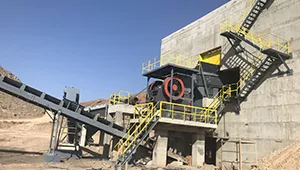
Cone crusher is used in the mining industry has been a very critical equipment, is a very good choice for crushing hard materials, cone crusher is mainly used in the secondary crushing, the processing capacity is relatively large, very trusted by users, so today on how to improve the production capacity of
cone crusher to give you a move, hoping to bring more benefits to users.
One. Keep the tight-edge discharge parameters unchanged
If you want to stabilize the output, quality and production line load of sand and gravel products, the first thing to ensure is that the parameters of the cone breaking edge discharge port remain unchanged, otherwise it is easy to lead to an unexpected increase in the particle size of the product, which will affect the entire production line system and the final output.
Two. Try to keep running "full" as much as possible
If a
cone crusher is "hungry" and "full" due to factors such as unstable feeding, then its product shape and product rate will also fluctuate. The products of the cone crusher running in the semi-cavity are not ideal in terms of gradation and needle flakes.
Three. Don't feed too little
Giving only a small amount of raw material will not reduce the burden on cone crushing, on the contrary, too little raw material will not only damage the product yield and poor particle shape, but also adversely affect the bearing of cone crushing.
Four. The feed drop point needs to be aligned with the center point of the cone breaking inlet
It is recommended to use a vertical deflector to guide the feed drop point in the center of the cone breaker inlet. Once the drop point is eccentric, one side of the crushing chamber is full of material and the other side is full of material or less material, which will cause adverse effects such as lower crusher throughput, more needle-like products, and large product particle size.
Five. Guaranteed uniform feeding
When feeding, it is necessary to avoid the situation that large particle size stones are concentrated on one side and small particle size stones are concentrated on the other side to ensure that the stones are mixed evenly.
Six. Buffer silo retention is minimized and line efficiency is improved
As the "enemy of output", the equipment and other related equipment also need to be carefully arranged.
Seven. Accurately grasp the three design ceilings of cone breaking
There are three design limits for cone crushers: the upper limit of throughput (capacity), the upper limit of power, and the upper limit of crushing force.
Eight. Guaranteed to operate within the crusher's design limit
If the cone crusher operation exceeds the upper limit of the crushing force (adjustment ring runout) or exceeds the rated power, you can slightly increase the parameters of the tight side discharge and try to ensure "full-cavity" operation, or reduce the feed rate, but this may not be possible to guarantee a good grain shape.
Nine. Monitor and try to ensure the right crusher speed
If the proper drive belt tension is not maintained, if it is not correct, or if drive maintenance is neglected, the belt will slip and the crusher speed will drop during the operation. The stone throughput of the crusher with a decrease in speed decreases sharply, while the power consumption increases sharply, the unit energy consumption rises, and the operating cost increases.
Ten. Control the fine content in the feed
Fine material in feeding: into the stone of the crusher, the particle size is equal to or smaller than the material set at the tight side discharge opening. According to experience, for the secondary cone crusher, the fine material content in the feed should not exceed 25%; The fine material content in the three-stage cone crusher feed should not exceed 10%.
Eleven. The feeding height should not be too large
For small and medium-sized cone crushers, the maximum suitable height of the material falling from the feeding equipment to the feed port is about 0.9 meters. If the feed height is too large, the stone is easy to "rush" into the crushing chamber at high speed, causing impact load to the crusher, and the crushing force or power exceeds the design upper limit.